
Yerevan, 10-12 August: AI Shield starts with the analysts who will carry it
The first activity of AI Shield brought CSIN and the Armenian Institute of International and Security Affairs together for three days of closed working sessions on organised, AI-supported disinformation aimed at Armenia.
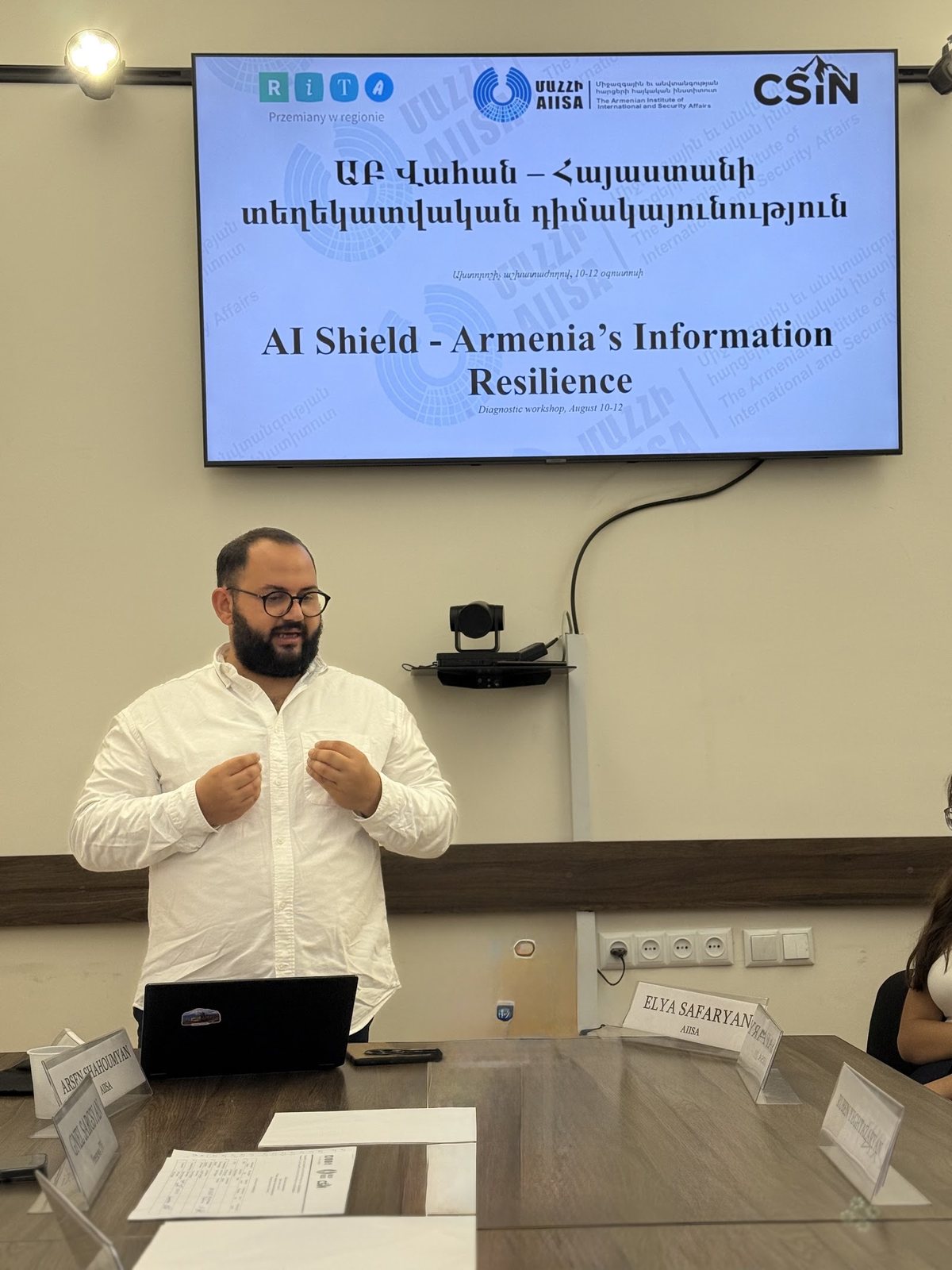
AI Shield is the first funded project of the Caucasian Social Innovation Network Foundation, run with AIISA in Yerevan. The August workshop opened a twelve-month cycle. Three days at the institute's office, with analysts from AIISA and from allied research centres and newsrooms, among them people who work on active operations and follow them daily.
The opening set out why the two organisations are working together at all. The operations aimed at this region are coordinated; the people defending against them usually are not. The same networks, the same rented infrastructure and the same narrative templates travel between the countries of the South Caucasus, and between this region and Central Europe. When a campaign is finished in one country, the machine is pointed at the next one.
Poland was the reference case, including the parts that did not work. On 24 February 2022 the information operation arrived in the same hours as the tanks. Fabricated stories about refugees were circulating in Polish before the first trains had emptied, built to turn a generous public instinct into resentment within a fortnight. The lesson carried to Yerevan was that the physical layer and the information layer are one attack, not two. The strike opens the wound; the operation decides who gets blamed for it.
That is not a Polish problem. The networks that cloned Polish news sites went on to build a France24 clone and a typosquatted environmental domain aimed at Armenian readers. Generative tools have removed the last barrier: a campaign that used to need a team of writers now needs one operator and an afternoon.
The working part of the three days was a threat map built with the room rather than presented to it, open-source investigation on real cases, and a live teardown of a fabricated story from the first post to the last amplifier account. Participants brought Armenian cases that appear in none of our briefs, which is exactly what the exercise was for.
The third day went to the design of the train-the-trainers course that starts in October. Between October and December, twelve to fifteen analysts go through 54 hours of training with mentoring in Armenian. From January 2027 those analysts run pilot workshops themselves, for thirty to thirty-six journalists and civil society staff. The cycle closes in spring 2027 with an analytical report, an expert panel and a toolkit in Polish, English and Armenian on an open licence.
The workshop was a closed session. There was no media accreditation and the venue was not announced in advance, because some participants face pressure at home for the work they do. What the room produced, however, is meant to travel: the monitoring data and case studies developed in Yerevan are being prepared for publication with sources.
Photos
AI Shield, Armenia's Information Resilience is run by the Caucasian Social Innovation Network Foundation together with the Armenian Institute of International and Security Affairs. Financed by the Polish-American Freedom Foundation under the RITA - Transformation in the Region programme, implemented by the Foundation for Education for Democracy.